
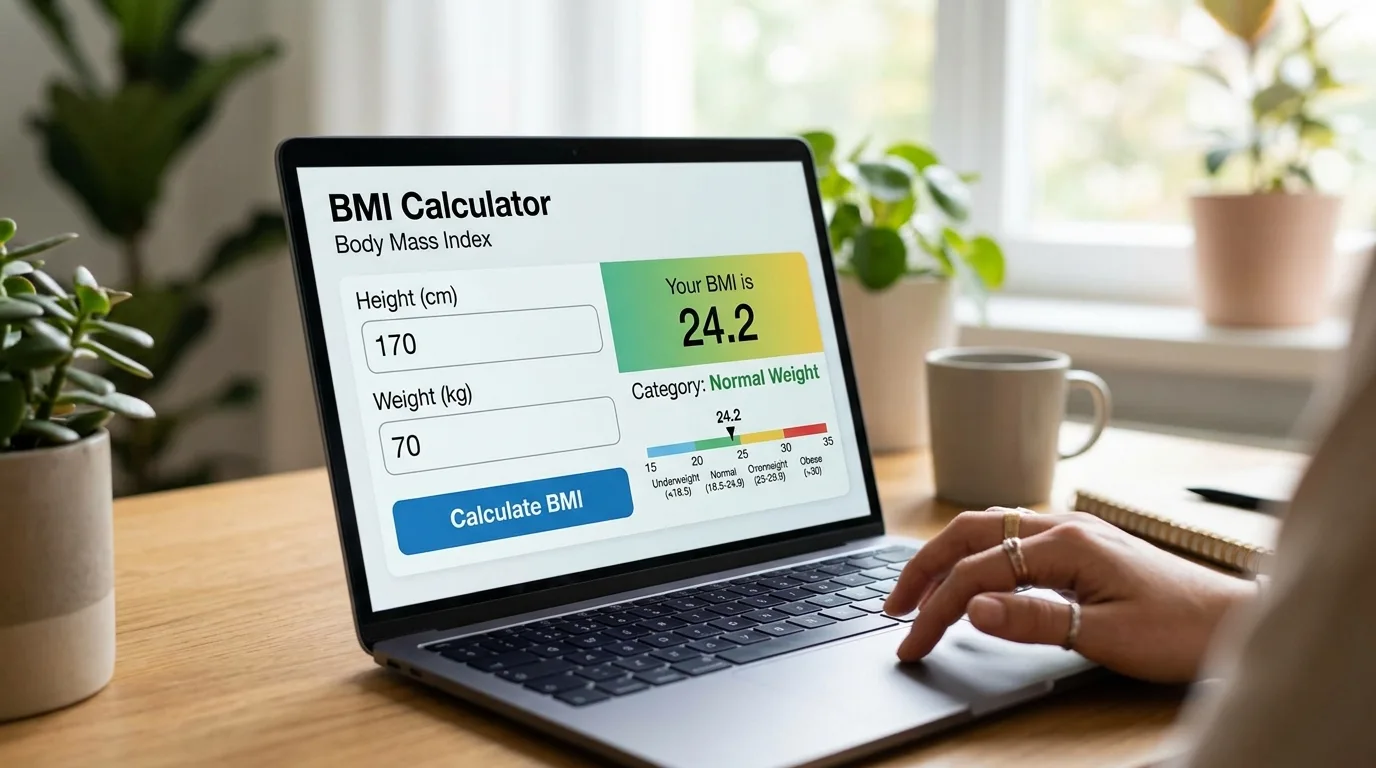
BMI Calculator: How to Calculate and Understand Your Body Mass Index
If you’ve ever wondered whether your weight is “healthy” for your height, chances are you’ve searched for a BMI calculator. It’s one of the fastest, simplest ways to get a general sense of where you stand – but the number itself only tells part of the story.
This guide walks you through how to calculate your BMI, what your result actually means, and why the “right” range can shift depending on your age, sex, ethnicity, and body type. By the end, you’ll understand not just your number, but what to do with it.
Estimate only, based on approximate CDC reference points (5th / 85th / 95th percentile by age and sex). Not a clinical diagnostic tool — for an exact percentile, consult your pediatrician or the CDC's official growth charts.
If you have ever wondered whether your weight is healthy for your height, you have probably searched for a BMI calculator. It is one of the most convenient tools for quickly getting a general sense of your weight profile. However, this number alone only tells half the story – the rest of the information simply cannot be captured by a single, cold numerical value.
This guide will walk you step-by-step through how to calculate your BMI, what that number actually means, and why the so-called “healthy range” can shift based on factors such as age, sex, ethnicity, and body type. By the end, you will not only be able to interpret your own BMI value, but you will also know what to do after you get that number, so you are not left confused, staring at a single figure.
What Is BMI?
BMI stands for Body Mass Index. It is a basic screening tool that uses only your height and weight to estimate whether your weight falls within a healthy range. No complex tests are required, and it costs nothing extra – you can calculate it on the spot.
BMI divides people’s weight into four broad categories:
Underweight – BMI below 18.5
Normal weight – BMI between 18.5 and 24.9
Overweight – BMI between 25 and 29.9
Obese – BMI of 30 or higher
These classifications give you a quick reference point; plugging in your own BMI lets you form a general judgment right away. But it is critical to understand what BMI can and cannot reflect. It cannot directly measure your body fat percentage or muscle mass, nor can it assess your overall health status. It is only a ratio of weight to height – nothing more. It cannot distinguish whether the weight on your body comes from solid muscle or excess fat. Even if two people have the exact same BMI, their body composition, fitness levels, and disease risks could be drastically different.
Even so, BMI remains a valuable initial screening tool. Many organizations, including the CDC, the National Heart, Lung, and Blood Institute (NHLBI), and the World Health Organization (WHO), use BMI as a basic screening method. The reason is simple: it is quick to calculate, costs nothing, and has decent accuracy for assessing population-level health risks, providing reliable input for public health statistics and large-scale screenings. The American Heart Association also references BMI alongside other metrics when evaluating cardiovascular risk. Never treat your BMI value as a final health diagnosis; treat it as a starting point for a health conversation with your doctor, not the final conclusion. It cannot produce any confirmed diagnosis – it can only help you initiate a health discussion with a professional to clarify what you should focus on next.
Calculate Your BMI: Formula and Example
You do not need an online calculator to figure out your BMI; you can compute it yourself with pen and paper – the formula is simple enough to get right every time. Before you start, confirm whether your recorded height and weight use metric units or imperial units – the calculation methods for the two unit systems are different, so do not mix them.
Metric formula (unit: kg/m²)
BMI = weight (kilograms) ÷ (height (meters))²
As a practical example, if you weigh 70 kilograms and are 1.75 meters tall, plugging these numbers into the formula gives:
70 ÷ (1.75 × 1.75) = 70 ÷ 3.06 = 22.9
This result of 22.9 falls within the normal weight range.
Imperial formula (unit: lbs/in²)
BMI = (weight (pounds) ÷ (height (inches))²) × 703
For example, if you weigh 160 pounds and are 5 feet 10 inches tall, that converts to 70 inches. Plugging the numbers into the formula gives:
(160 ÷ 4900) × 703 = 0.0327 × 703 = 23.0
This result of 23.0 also falls within the normal weight range.
The number 703 in the imperial formula is not random. It is a unit conversion constant whose only role is to adapt the metric formula, which uses kilograms and meters, to work with pounds and inches in the imperial system. Once you calculate your BMI, you can compare it to the weight classification standards mentioned earlier to see which category your number falls into.
A small but important reminder: never mix different unit systems. If you record your height and weight in different units – for example, your height is in feet and inches but your weight is in kilograms – you must first convert all values to the same unit system, either all metric or all imperial, before plugging them into the formula. If you combine kilograms with feet, or centimeters with pounds, the final number will be wrong and completely useless as a reference.
After calculating your BMI, you can also work backward to find the ideal weight for your height – this ideal weight is the value that places your BMI in the middle of the normal range, roughly between 21 and 22.
Is It Different for Men and Women: BMI Calculation for Males and Females
The core formula used to calculate BMI is exactly the same for men and women; there is no separate formula based on sex. However, the way you interpret the same BMI value can be completely different for people of different sexes.
At the same BMI, women naturally have a higher body fat percentage than men, due to differences in physical structure and hormone levels, not because of a personal health problem. In other words, even if a man and a woman have the exact same BMI, their total body fat amounts can differ greatly, and the health risks tied to that difference can also vary.
This does not mean you need a special formula to calculate your own BMI. It means that when you discuss this number with your doctor, they will not base their judgment solely on it; they will consider your sex along with other factors such as waist circumference and body fat percentage to provide tailored analysis and advice.
Healthy Range Changes as You Get Older: BMI at Different Ages
For most adults – generally people between the ages of 20 and 65—the standard BMI weight classification system is fully applicable. Whether you are 20 or 60 years old, this standard works regardless of age. The World Health Organization applies the same fixed set of BMI range standards to all adults in this age group, without splitting standards by age.
However, when this unified standard is applied to older adults, a widely recognized flaw emerges: it cannot perfectly adapt to the physical conditions of older people.
BMI for Older Adults
As people age, their body composition naturally changes. Even if your weight on the scale is identical to what it was when you were young, muscle mass will gradually be lost, while fat may quietly accumulate. Many professional health organizations, including nutrition agencies in several countries, have offered a different perspective: for older adults, a BMI slightly higher than the general healthy standard is not necessarily harmful and may actually help the body withstand certain health risks. For example, a value that would classify a 30-year-old as “overweight” could be completely reasonable, even beneficial, for a person in their 70s.
The standard BMI range developed by the World Health Organization does not account for the age-related changes in older adults’ bodies. If you are a senior, or you are calculating BMI for an elderly family member, do not treat that standard range as a rigid target you must hit; use it only as a general reference. After getting that number, be sure to talk to the older person’s primary care physician. Only by combining their specific age, usual physical state, and any chronic conditions can you determine what weight range is suitable for that individual.
BMI for Children and Teens: Why It Is Calculated Differently
The basic formula for calculating BMI for children is exactly the same as for adults: weight divided by height squared. But after getting the number, you cannot directly apply the adult standards to judge whether it is healthy.
All the differences between pediatric and adult BMI lie in how you assess whether the number is appropriate after you calculate it. Children are constantly growing taller and developing; the “healthy BMI” that is fixed for adults shifts as children age and their bodies mature, so there is no single fixed value that works forever.
For this reason, a child’s BMI result cannot directly use the adult fixed classifications of “underweight, normal weight, overweight, obese.” Instead, it must be assessed against growth percentile curves created specifically for children of different ages and sexes. For example, the same BMI value that falls in the normal range for a 5-year-old might be classified as underweight or overweight for a 10-year-old. The specific classification depends entirely on where that number falls on the percentile curve for the corresponding age group.
When calculating BMI for a child in your family, be sure to use a BMI calculator designed specifically for children; do not input their data into a regular adult calculator. The classification standards and what each category means are completely different between the two types of calculators, and they cannot be mixed.
An additional note about infants: BMI is generally not used for babies under one year old. Pediatricians use another set of specialized growth curves to track an infant’s weight-for-length, head circumference, and other data to assess development, because BMI only provides meaningful reference data once a child reaches around 2 years old. It is not useful for younger babies.
One last easily overlooked detail: using percentiles to assess BMI is not exclusive to children. In some clinical research and public health statistics settings, researchers or public health staff may also calculate BMI percentiles for adults, comparing an individual’s BMI to population-level data for health tracking or academic research. But this use is far less common than the four-category standard for ordinary adults, and you will almost never encounter it when measuring your own BMI at home.
The BMI classification standards we commonly use never accounted for the unique physical changes of pregnancy. If you are pregnant and apply pre-pregnancy BMI standards to your current weight, the result could easily mislead your assessment of your health status.
From conception to childbirth, gradual weight gain is not only normal, it is essential – this weight supports the growing fetus, maintains proper placental function, and keeps up with changes in the pregnant person’s body to sustain the pregnancy. What is a healthy amount of weight to gain during an entire pregnancy? That number is not fixed; it depends heavily on your pre-pregnancy BMI. If your BMI was in the “normal” range before you conceived, the weight gain goal your doctor recommends will be completely different from the goals for people who were underweight or overweight before pregnancy. These individual differences cannot be covered by general BMI standards.
That is why an ordinary BMI calculator is completely unsuitable for assessing whether weight during pregnancy is healthy. Its only appropriate use is to calculate your baseline weight status as a general reference before you plan to become pregnant. If you are already pregnant and are unsure how much weight you should gain, it is best to consult your OB-GYN or a midwife. They will consider your pre-pregnancy weight, past medical history, and current gestational age to provide recommendations tailored to you.
BMI and Ethnicity: Why Cutoffs Aren’t the Same for Everyone
Research has long found that people from certain ethnic groups are more likely to develop chronic conditions like type 2 diabetes and cardiovascular disease even at BMI levels lower than the general healthy standard – but most people have never noticed this. It is one of the most easily overlooked flaws in how BMI is applied, but it has a very real impact on how you assess your own health risks.
Specifically, groups including East Asian, South Asian, Black African, African-Caribbean, and Middle Eastern populations often develop the chronic conditions mentioned above at BMI values lower than the mainstream accepted threshold.
Supported by this research, some health guidelines have specifically lowered BMI cutoffs for these groups. For example, many guidelines created for East Asian populations have moved the start of the “overweight” threshold from the commonly used 25 to 23—because research has confirmed that for East Asian people, health risks begin to rise once BMI reaches the lower value of 23.
For you personally, this means that if you belong to any of the groups mentioned above, even if a standard BMI calculator puts your value in the “normal” range, it is best to discuss your situation with a doctor. Your personal health risks may not align with the cutoffs built into that general calculator.
This is not an empty suggestion. The UK, India, and South Korea have all released public health guidelines stating that the original Western BMI cutoffs need to be adjusted for their national populations. As of yet, however, no unified adjustment plan that can be used globally has been formally rolled out everywhere.
BMI Calculation for Athletes and People With High Muscle Mass
One of BMI’s well-known flaws is that it cannot distinguish whether weight comes from muscle or fat, and this problem becomes especially pronounced in people who have far more muscle mass than the average person. This metric only factors in your weight and height; it cannot break down what your weight is composed of. For many people with dense muscle and low body fat, the BMI classification is often worse than their actual physical health status – they are perfectly healthy, yet they are calculated as overweight or even obese. A classic example: a professional bodybuilder may have a body fat percentage of just 10%, extremely lean, yet their calculated BMI could fall into the clinical “obese” range. The reason is simple: muscle is denser than fat, so the same volume of muscle weighs much more than fat. If you are a professional athlete, regularly strength train, or naturally have higher-than-average muscle mass, your BMI value will not reflect your true health status. In this case, do not fixate solely on BMI; it is best to measure a few other metrics to use as references alongside it:
Body Fat Percentage: directly calculates what share of your weight is fat and what share is lean mass, including muscle, bone, and other non-fat tissue
Waist-to-Hip Ratio and Waist Circumference: help you identify where fat is stored on your body, and are strongly correlated with many specific health risks
These two metrics cannot replace in-person conversations with your doctor or a professional fitness coach, but combining them with BMI creates a far clearer picture of your health than BMI alone.
Limitations of BMI: Is It Still a Reliable Measure?
BMI has been used worldwide for decades, and today some people ask if it can still serve as a reliable health measure. This question is completely reasonable. To be clear, BMI is useful, but it has unavoidable flaws. Its problems stem from a few key points:
First, it cannot distinguish between muscle and fat, as mentioned earlier. This flaw misclassifies many muscular people into categories that do not match their true situation.
Second, it cannot see where fat is stored on the body at all. The location of fat accumulation itself is critical: fat stored around the abdomen carries higher health risks than fat stored in other areas, but BMI cannot detect this difference.
Third, its general standards do not account for differences in age, sex, and ethnicity, yet each of these three factors alters the actual health risk associated with the same BMI value. Applying the same standard to everyone is inherently unfair.
Fourth, even if your BMI falls in the “normal” range, that does not guarantee you are healthy. Your calculated weight-to-height value may be fine, but you could have an elevated body fat percentage, poor cardiorespiratory fitness, or metabolic health issues – the condition commonly known as “skinny fat.”
Finally, it was never intended as a tool to make individual health diagnoses. BMI was originally invented as a macro-level metric for population statistics, not as a tool for ordinary people to use for a precise personal health assessment.
Even after listing all these flaws, that does not mean BMI is completely useless – it remains a quick, free screening tool that provides valid reference information, and its role in tracking the overall health trends of large populations cannot be replaced. For individuals, however, it should only be one of many reference data points, not the sole number you use to issue a final judgment on your health.
Other Health Metrics: Comparing BMI to Additional Health Indicators
Because of these widely recognized flaws of BMI, people commonly use it alongside or in comparison with other metrics, which fill in the information gaps that standard BMI calculations miss.
- First, compare BMI to body fat percentage.
As the name suggests, body fat percentage measures what share of your weight is fat, with the remaining weight being muscle, bone, and other body tissues. Unlike BMI, it directly addresses the flaw of being unable to distinguish muscle and fat – the same flaw that misclassifies many muscular people. But body fat percentage has its own drawbacks: to get an accurate measurement, you usually need specialized tools like skinfold calipers, bioelectrical impedance body fat scales, or a DEXA scan at a hospital. You cannot calculate it on the spot just by inputting two numbers, as you can with BMI.
- Next, compare BMI to waist-to-hip ratio and waist circumference.
Waist-to-hip ratio and waist circumference focus on where fat is stored, not your total body weight. Abdominal fat accumulation is far more strongly linked to heart disease and various metabolic issues than fat stored in other areas, so these two metrics can identify many health risks that BMI might miss. They are especially useful for people whose BMI appears “normal” but who carry most of their excess fat around their waist.
More recently, newer comprehensive metrics have been proposed, such as the Body Roundness Index (BRI), which combines height, weight, and waist circumference to produce a single score. These new tools are still in the process of gaining widespread adoption; they have not yet become routine tests for most medical institutions, but they represent a clear trend: people are no longer satisfied with assessing health using only the simple parameters of height and weight. In most cases, combining BMI with any supplementary metric will give you a more comprehensive understanding of your health status than fixating on a single number.
All branches of the military, including the Air Force, use BMI as the first step in fitness screening for new recruits and active-duty personnel, but they do not make judgments based solely on that number. If someone’s BMI does not fall within the specified normal range, most branches then measure body fat percentage using a simple method: a soft tape measure to record neck and waist circumferences, and for women, hip circumference as well. Compared to BMI calculated only from height and weight, these body fat percentage readings from circumference measurements correlate more strongly with service members’ actual ability to meet fitness standards.
The military uses this layered assessment for the same reason BMI cannot accurately assess many athletes: some service members train year-round and have high muscle mass, so relying solely on a single BMI metric could easily misclassify people who are actually in good physical condition as unfit.
What to Do After You Get Your BMI Result
Calculating your BMI is only the first step; what matters more is what you do after you receive your result.
If your result falls in the underweight range, it may sometimes indicate insufficient nutrient intake or an underlying health issue, though it could also simply mean you have a naturally lean build. It is recommended that you discuss this with a doctor, and if you also frequently feel tired or get sick easily in addition to having a low BMI, it is even more important to take this seriously.
If your BMI falls in the normal range, this is generally a good sign, but that does not mean you can ignore other health factors – your blood pressure, cholesterol levels, usual amount of physical activity, and daily diet all still matter.
If your result falls in the overweight or obese range, do not treat this as a final, definitive health sentence. Instead, treat it as a prompt to pay more attention to your health.
You can measure other metrics alongside it, such as waist circumference and body fat percentage, and use those details as additional reference points.
You can also talk to your doctor about your personal health risks and family medical history and plan what steps to take next – whether that means adjusting your diet, increasing your physical activity, or undergoing further testing, you can work with your doctor to make a plan.
If you need to adjust your weight and want to maintain healthy long-term changes, the core principle is to balance the calories you consume with the calories you burn. Beyond that, factors like sleep, stress levels, and daily activity levels must also be considered. A single BMI number cannot account for all these complex details, which is why BMI is best used as a starting point to open a conversation about health, not as the basis for a final conclusion on your health status.
Frequently Asked Questions
Q: What is my ideal weight, according to BMI?
Many people calculate BMI hoping to find a personal “ideal weight,” thinking that hitting that number means everything is fine. In reality, there is no universal “ideal weight” that works for everyone. BMI only calculates a healthy weight range that matches your specific height; the BMI values corresponding to this range are usually between 18.5 and 24.9. As long as your weight stays within this range, you meet the general health standard. Where you fall within that range does not need to hit a fixed number; it depends on your natural frame size, muscle mass, and personal medical history. The specific weight that is right for each person is inherently different.
Q: Does BMI include body fat in its calculation?
No. BMI only uses the ratio of your total weight to your height; it cannot distinguish whether your weight comes from muscle, fat, or bone. Because of this limitation, BMI is most often used alongside other measurements like body fat percentage and waist circumference to build a more complete picture of your body’s condition and assess your health more comprehensively. A single BMI number is not enough.
Q3: Is the BMI calculator free to use?
Yes. All commonly used BMI calculators, including the one hosted on this website, are free to use, with no need for any specialized testing tools – you only need to input your height and weight to get an immediate result, with a very low barrier to entry for anyone who wants an initial self-check.
Q4: Are BMI standards for the military different from those for the general public?
Yes. All military branches, including the Army, Navy, and Air Force, use BMI only as a first step in initial screening and do not make final decisions based on it. For a complete, accurate health assessment for enlistment or continued service, they rely more on body fat percentage and the various body circumference measurements taken with a soft tape measure. You can find more details in the section above this FAQ.
Q5: Can I be unhealthy even if my BMI is normal?
Yes. It is entirely possible for your BMI to fall in the “normal” range but for you to have a high body fat percentage, poor cardiovascular endurance, or get winded climbing just two flights of stairs – this condition is often called “skinny fat.” Remember, BMI has always only been an initial screening tool, not a comprehensive health assessment. So even if your result is in the normal range, that does not mean you have no other underlying health issues. Do not let your guard down just because you get a normal BMI result.